


Blog
Closed-Door Congress vs. Open Exhibition: The Real Difference for Pharma Companies
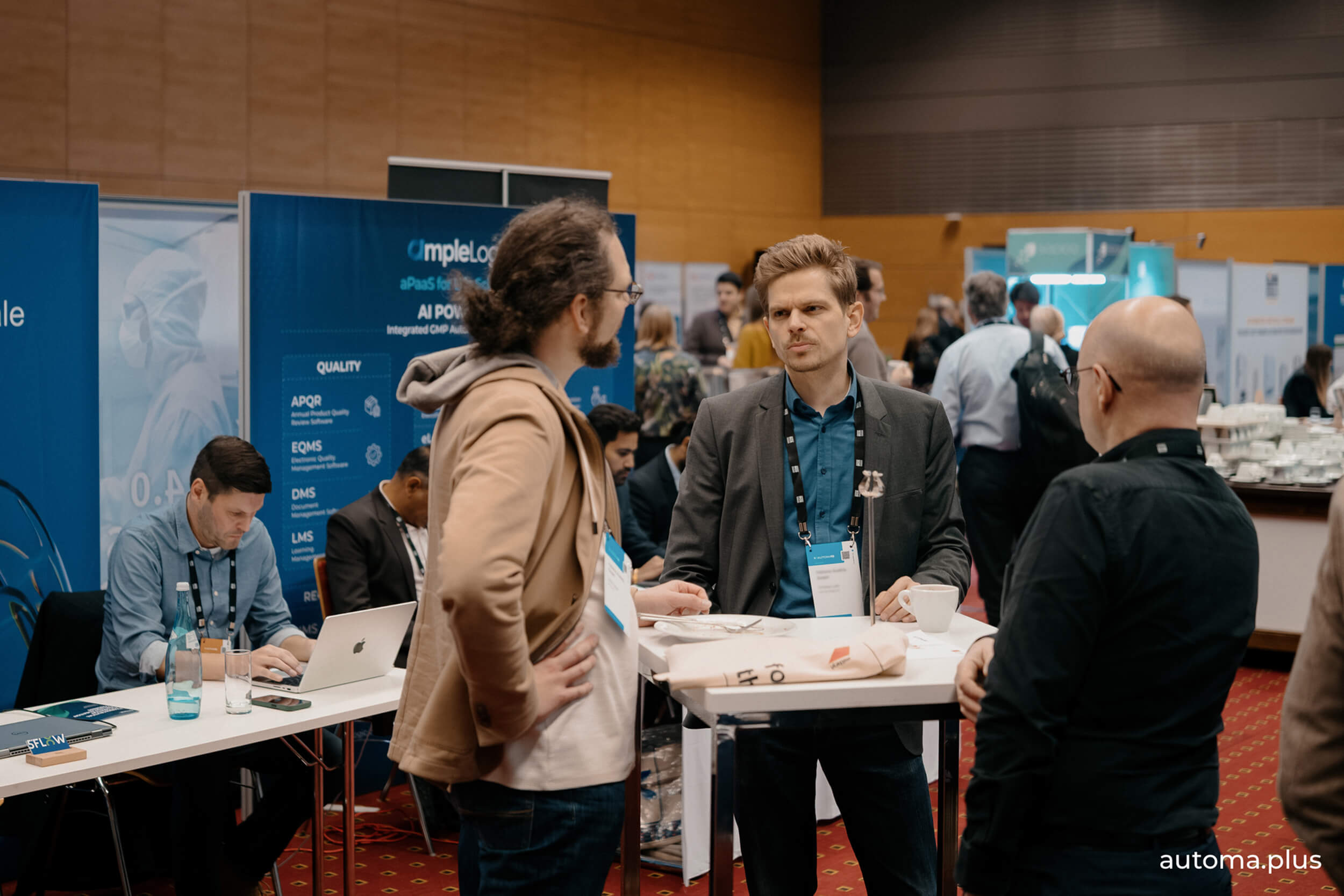
A closed-door congress runs on different mechanics than an open exhibition, even though both often get labeled "industry event" in a marketing budget. For pharmaceutical companies, the difference shows up in several places: how leads convert, who ends up in the room, what participation includes, how much competition sits nearby, and what the business programme covers. Knowing that difference before choosing where to send next year's budget changes both the ROI and the cost of participating.
Why Industry Events for Pharmaceutical Companies Split Into Two Formats
Many pharma automation suppliers still treat "industry event" as one category, built around a booth and foot traffic. CEIR, the exhibition industry's own research body, has tracked why people walk trade show floors for 25 years running. The top reason hasn't moved: 92% of attendees come to see new products and compare suppliers rather than to make a purchase decision. That's browsing behavior, and pharma automation buyers know it well. A CDMO process engineer or a plant IT lead has scanned enough badges at a hall show to expect a brochure, a business card or a follow-up email that goes nowhere.
A closed-door congress works from the opposite premise – delegates commit to a set number of arranged meetings before they arrive. Both sides of every conversation are confirmed before anyone travels, and the organiser treats the meeting schedule as the product and is responsible for it.
Lead Conversion and ROI: 1.9% vs. 13%
A 2026 hosted-buyer benchmark study cited by Converve found trade-show booth conversations close at 1.9%. Pre-scheduled meetings close at 13%, nearly seven times higher. Vendelux's own funnel data shows the same pattern earlier in the pipeline: a pre-booked meeting converts to a qualified opportunity 25-40% of the time, against 15-25% for a booth conversation flagged hot on the spot. That gap is what ultimately decides ROI: a format that closes seven times more often needs far fewer contacts to pay for itself.

For a pharma automation vendor, that gap compounds. A GMP validation review and a capital sign-off already stretch the sales cycle past a year. Starting that clock with a scanned badge instead of a confirmed counterpart adds months nobody budgeted for.
How to Choose an Industry Event: Start With Who's in the Room
Forrester puts the average B2B buying committee at 13 people, rising towards 25 for complex technology purchases. On an exhibition floor with thousands of badges, the odds of catching the two or three people who sign off on a MES rollout or a digital-twin investment shrink as the floor gets bigger.
AutomaPlus replaces that lottery with vetting. BGS Group, as the organiser, checks every participant's company, role and specialisation before sending the invitation. The Congress holds draws roughly 250 participants from over 30 countries: pharma operations leaders, CMOs and CDMOs, equipment manufacturers and IT providers. That's the specific committee that signs off on automation spend.
Alex Chekel, Digital Transformation and Innovation Advisor at Innowise: "AutomaPlus managed to gather all the best talents and top-notch companies across the industry. The congress itself is on the edge of pharma and IT which helps to narrow down the list of participants to those who really one way or another relates to this sector. That means you don't have many people, you don't have crowds, which is good and comfortable. At the same time, whenever you stumble upon someone and you're talking to someone the probability of meaningful conversation is much higher if you compare this to the big conferences that have no certain narrow topic."
Want to know who will be at AutomaPlus 2026 on 16-17 November? Request the confirmed participants list
Where an Exhibitor's Leads Disappear After a Trade Show
Even a well-staffed booth loses ground after the show closes, in four predictable spots:
-
Participants skip meetings they arranged on the spot once the calendar fills; pre-arranged meetings show up 80-90% of the time by comparison.
-
Attendees give each booth only 3-5 seconds as they move through the hall. Most can't plan visits ahead because they don't know who else will be there: Vendelux found 70% of B2B teams cite exactly this, a lack of visibility into attendee lists, as their biggest obstacle to booking meetings before an event.
-
Collected badges often sit untouched afterwards: a typical exhibitor scans hundreds of contacts per show and follows up with fewer than one in ten.
-
Only 37-49% of exhibitors measure results or track ROI formally at all.
All these leaks trace back to how the exhibition format itself is built. A closed-door structure is designed to eliminate them one by one, starting with the meeting schedule itself.
What Participation in a Closed-Door Pharma Congress Includes
Participation in a closed-door event starts well before anyone arrives. The organiser assembles the room first, vetting delegates by company, role and project so the audience already matches what a specific vendor or end-user is trying to solve. The business programme and the exhibition are built the same way: from a pre-event survey of what vendors and end-users on both sides want to discuss.
The business meetings aren't left to chance either. International hosted-buyer practice sets a working range of 12-20 meetings per delegate over two days, and AutomaPlus builds its schedule inside that range. A named account manager works with each delegate ahead of the Congress to confirm goals, propose the right counterparts and hold the calendar together once the doors open – participants don’t spend the two days guessing who to talk to next.
Harald Schnidar, CEO at SCARLETRED Holding GmbH: "I think a personal manager is super important because you have a direct person who takes care of your aims. It's teamwork and as always the more people work together, the better you're aligned, the better is the outcome. In our case, our personal manager helped us to reach out to specific people, coordinate meetings and also streamline the whole procedures that we have planned for this event. It increased the success rate and we're very happy with what we've got."
Visibility vs. Deal-Making: What Each Format Buys
Every industry event optimises for one of two things: visibility or deal-making.
An open exhibition is built for reach. A pharma operator evaluating automation platforms might pass thirty vendors offering some version of the same SCADA or MES layer before lunch, and that volume is the point: more badges scanned, more brand exposure across the market.
A closed-door congress optimises for the opposite variable. The organiser builds each delegate's meeting schedule around several suppliers relevant to their specific project instead of the widest possible audience. Attention doesn't fragment across thirty pitches, so fewer, better-matched conversations cost less to generate than one competing for attention with thirty neighbors, and each one is aimed at someone who can actually sign off on a deal.

Inside a Closed-Door Congress: AutomaPlus 2026, 16-17 November in Zurich
The AutomaPlus business programme is built from a pre-event survey of participants' actual priorities: data integrity, MES and digital-twin rollouts, FDA/EMA-aligned automation and more, so conversations start from a shared agenda instead of a generic keynote. That matters most while pharmaceutical companies are still filling out their 2026-2027 conference calendar and weighing which events are worth the travel budget.
Luuk Seelen, Group Director Manufacturing Intelligence at Octapharma, about AutomaPlus 2025: “On the one hand, I had interesting talks with some colleagues from the industry about which solutions are out there from the vendors. On the other hand, I heard how other companies overcome certain challenges. I think this is the nice thing about AutomaPlus – it brings digitalisation tools, but also the experience from the industry that gives you this extra layer of what you can take back to your company.”
If you’re weighing AutomaPlus 2026 in Zurich – request this year's brochure and see which topics, speakers and exhibitors are already confirmed.
FAQ
What is AutomaPlus 2026?
AutomaPlus 2026 is the Pharmaceutical Automation and Digitalisation Congress, bringing together senior decision-makers and specialists from pharmaceutical manufacturers, CMOs, CDMOs, equipment suppliers and technology providers to address the practical challenges of automation, digitalisation and manufacturing excellence in pharma. The programme covers MES, SCADA, LIMS, AI in manufacturing, GMP compliance, quality systems and digital infrastructure for regulated environments.
When and where does AutomaPlus 2026 take place?
AutomaPlus 2026 takes place on 16-17 November 2026 in Zurich, Switzerland, across two days of sessions, roundtables, an exhibition and structured B2B meetings with participants from the pharmaceutical value chain.
Who attends AutomaPlus 2026?
AutomaPlus 2026 is attended by C-level executives, heads of automation, digitalisation leads, manufacturing directors, quality and engineering specialists from pharmaceutical operators, CMOs and CDMOs, alongside equipment manufacturers, system integrators and technology providers serving the regulated pharma environment. The Congress operates on a closed-door model to ensure a focused professional environment of end-users, licensors and solution providers.
How do companies participate in AutomaPlus 2026?
Companies participate in AutomaPlus 2026 as delegates, sponsors, exhibitors or speakers. Participation details are available on request.
Is AutomaPlus the same as a pharma trade show?
No. AutomaPlus replaces open floor traffic with a vetted delegate list and pre-arranged meetings, closer to a hosted-buyer programme than a traditional exhibition, while still keeping a physical exposition delegates pass throughout the event.
Why does lead conversion differ so much between an exhibition and a closed-door congress?
Both sides of a closed-door meeting are vetted and confirmed before the event, instead of relying on chance encounters on a show floor. Booth conversations close at 1.9%, pre-scheduled meetings at 13%, according to a 2026 Converve benchmark study.
References
-
Vendelux: Benchmarks, Funnel, Statistics 2026, KPIs
-
Cvent: Event Statistics 2026, Webinar Statistics, Trade Show Budgets
-
CEIR via PurExhibits, Trade Show Executive, Makai, ExOptions