


Blog
AutomaPlus 2026 in Zurich: Key Takeaways from the Pharma Automation and Digitalisation Congress
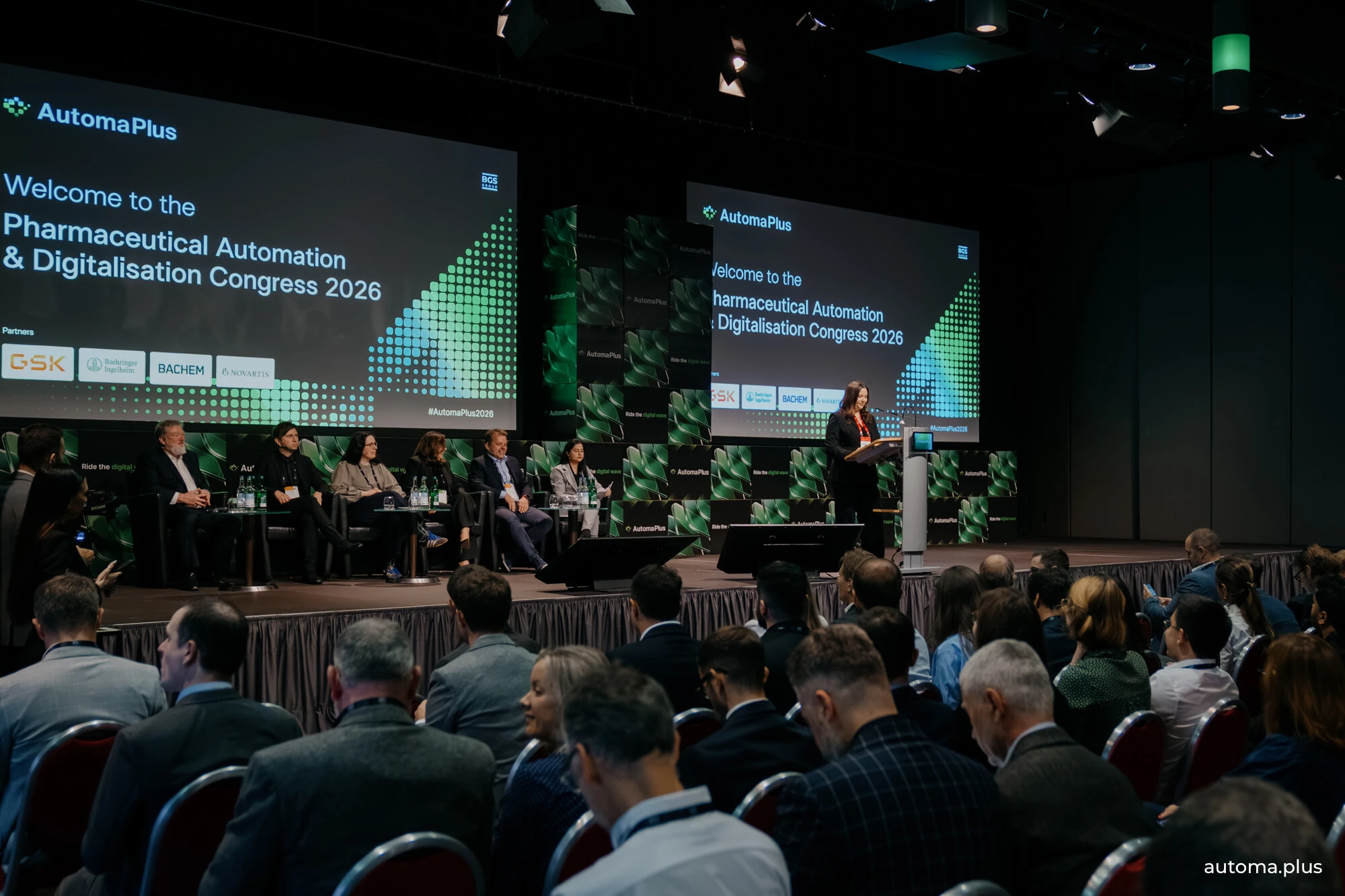
AutomaPlus 2026, the Pharmaceutical Automation and Digitalisation Congress, brought 266 delegates from 135 companies to Zurich, Switzerland, on 16-17 November. More than 20 hours of cases and discussions focused on AI and data in pharma, and between sessions delegates held 177 B2B meetings.
Who attended AutomaPlus 2026
AutomaPlus 2026 brought pharmaceutical and biotech companies together with technology and solution providers. Many of them knew the format already: 63% of companies return to AutomaPlus.
GSK, Bachem, Novartis and Boehringer Ingelheim Pharma joined as Partners. Matterport supported the Congress as the Principal Sponsor, SCARLETRED Holding GmbH as the Platinum Sponsor and Craftware Sp.z o.o. as the Diamond Sponsor. In total, 26 sponsors and partners and 26 leading media houses joined AutomaPlus 2026.
Gerald Kiener, Manager Global Business Development at AGILOX Services GmbH (Gold Sponsor), found the range of perspectives from different divisions inspiring for his own company's work. He described AutomaPlus as “effective, inspiring and very well organised”.
Key topics at AutomaPlus 2026: AI and data in pharma
Over two days, 51 speakers took the stage across 10 sessions. AI ran through almost every talk, and the questions around it were practical: how to take a pilot to several sites and what data foundation that requires in a GxP environment. Governance emerged as a second thread, with several speakers arguing that process and standards now set the pace of AI adoption as much as the technology does. This recap looks at three sessions from the programme.
Opening panel: how AI is changing pharma operations

In the Executive Opening Panel, “AI: Exploring New Frontiers, Facing New Challenges”, Martin Mayer, Business Line Director for Digital Solutions at ZETA GmbH (the Opening Panel Sponsor), built his talk around one thesis: “In pharmaceutical manufacturing, the greatest challenge is no longer automation. It is orchestration.” Digital twins and modular plants can connect today's “digital islands”, so teams test a decision in the virtual plant before carrying it out in the physical one.
Yolanda Cabrera-Sybesma, CEO at CiNTL Pharma B.V., looked at how well CROs and pharma companies align their technology with what faster global trials need, and Harald Schnidar, CEO of SCARLETRED Holding GmbH, presented AI-powered skin imaging and digital skin biomarkers for clinical R&D.
Olga Drozdova, Supply Chain Performance Management & Analytics Lead at Takeda, showed how AI moved from one of several enablers in Takeda's 2024 digital roadmap to reshaping all five of its “steppingstones”.
Thomas Halfmann, Head of Pharma Strategy & Growth at Seqonis by eschbach (Gold Sponsor), spoke about AI-powered root cause analysis and problem solving: “The real value of AI is not simply finding root causes faster. It is solving problems sustainably, preventing recurrence, and transforming operational performance.”
Scaling AI in pharma beyond the pilot stage

Leaders Talk 2, “Smart Data: Driving the Digital Future”, started from AI that works in a pilot and goes no further. Fabian Kleiser, VP Technology at Mimacom AG (the Leaders Talk Sponsor), put figures on the gap: 80% of people say AI makes them individually faster, yet only 37% of organisations can point to any profit impact. Value appears where teams redesign the workflow around AI, and in a GxP environment that takes longer than anywhere else. For Fabian Kleiser, this makes scaling AI “an engineering problem before it is an AI problem”.
Cédric Colon, Global Supply Chain Strategy Programme Management Global Process Owner at GSK, defined smart data as high-quality, governed and interoperable data paired with AI analytics and embedded into workflows.
Krzysztof Bokiej, Principal Architect at Craftware Sp.z o.o., presented an AI-assisted platform that drafts clinical and regulatory documents section by section from approved templates, while experts keep final accountability.
Evgeny Galimov, Principal Data Scientist at Phastar, shared lessons from AskRWD Lite, an AI agent that lets clinicians query real-world data in plain language instead of waiting weeks for a data scientist.
Moritz Wullschleger, Head of Automation & Industrial Digitalisation, and Stefan Pauli, SME Data Science, both from VTU Engineering Schweiz AG (Bronze Sponsor), presented a cement plant case where a self-optimising raw-mix recipe saves around 70,000 tonnes of CO2 a year.
Matthias Duisberg, Senior Business Manager Catalysts EMEA at Evonik, showed how combining digital tools with catalyst expertise brought a 20% improvement in space-time yield in a chemical manufacturing case.
Closing panel: building the data foundation for pharma digitalisation

In the Closing Panel, “Shaping the Future with Data, AI, and Collaboration”, Monitha Harilkumar, Vice President, Head of Life Science CoE at Cognite AS (the Closing Panel Sponsor), traced stalled pilots to data trapped in separately validated systems, so every new site means manual data extraction and a fresh round of GxP validation. Her answer is a governed, reusable data layer that links data tags to equipment, batches and timestamps.
Maz Ahmad, Director of Automation & Digital Innovation at Cell and Gene Therapy Catapult, examined “the missing middle” between innovation and implementation: companies lack environments where they can trial technologies before deployment. He made the case for shared, pre-competitive piloting environments.
Judith Koliwer, Senior Industry Advisor & Principal Consultant Advanced Therapies, and Frederik Thiele, Business Development Line Optimizer, both from Körber Pharma Software (Gold Sponsor), showed how connecting ISA-95 Level 2 and Level 3 systems creates a digital thread across the product lifecycle.
Alessandro Raimondo, Knowledge Transfer Officer at CERN, the European Laboratory for Particle Physics, said: “AI's greatest potential often lies in learning from data that cannot – and should not – be moved.” CERN's federated AI platform CAFEIN® lets organisations train AI models together while sensitive data stays with its owner.
Xinyan Li, Medical GenAI lead at ViiV Healthcare, drew on building an AI-enabled medical content platform: “technology no longer sets the pace. Process and governance do.” Her investment logic: rent models and tools on short commitments held to a one-year payback test, and own the know-how, standards and governance they run within.
Pharma automation exhibition
The Focus Exhibition brought together 40 exhibitors. Their solutions covered automation and digitalisation for pharma, from software and data management to X-ray detectors and robotics. Between sessions, delegates could explore these technologies up close and see how far the industry has come in putting them to work.

Alejandro Rodriguez, Co-Founder at Peptide Dynamics LLC, valued exactly this view of the industry. He recommends AutomaPlus to “anyone who is serious about knowing and understanding where the industry is in terms of digitalisation and AI adoption”.
B2B meetings and the gala dinner
Delegates held their 177 B2B meetings in the exhibition and coffee break areas and in the dedicated B2B meetings room. We thank Systec & Solutions GmbH (the Coffee Break Sponsor) and ERSistemi (the VIP meeting room Sponsor) for supporting the conversations.
Over more than 20 hours of networking, delegates met peers and potential partners and compared how they plan to use automation in the years ahead. Devendra Ridhurkar, Founder and CEO at RidNova Pharmaceuticals, sees the Congress as an effective platform for this: “I’d like to recommend AutomaPlus for the scientists who want to develop and network and learn about the automation that we are going to use in the next 3-4 years in the pharmaceutical industry.”
The first day ended with a Gala Dinner. A jazz band and a magician set the mood, and the lottery gave away gifts from the AutomaPlus team and the Congress sponsors.

“Over the past two days, you have shared ideas, discussed challenges, explored opportunities and hopefully found new ways to collaborate. We look forward to continuing these conversations next year in Zurich – reconnecting with familiar faces, welcoming new ones and discovering what’s next for the industry”, – Yuliya Glazyrina, AutomaPlus Congress Director.
AutomaPlus 2027 in Zurich: dates and registration
AutomaPlus returns to Zurich on 15-16 November 2027 for its seventh edition, and registration is already open. The closed-door format stays: delegates get the attendee list, plan their meetings in advance and have a personal manager's support throughout the Congress. The programme will cover responsible AI, lab automation, intelligent digital manufacturing, regulatory affairs and compliance, supply chain decisions and data-driven quality.
Learn more about AutomaPlus 2027
FAQ
What is AutomaPlus?
AutomaPlus is the Pharmaceutical Automation and Digitalisation Congress, bringing together senior decision-makers and specialists from pharmaceutical manufacturers, CMOs, CDMOs, equipment suppliers and technology providers to address the practical challenges of automation, digitalisation and manufacturing excellence in pharma. The programme covers MES, SCADA, LIMS, AI in manufacturing, GMP compliance, quality systems and digital infrastructure for regulated environments.
When and where does AutomaPlus 2027 take place?
AutomaPlus 2027 takes place on 15-16 November 2027 in Zurich, Switzerland, across two days of sessions, roundtables, an exhibition and structured B2B meetings with participants from the pharmaceutical value chain.
Who attends AutomaPlus 2027?
AutomaPlus 2026 is attended by C-level executives, heads of automation, digitalisation leads, manufacturing directors, quality and engineering specialists from pharmaceutical operators, CMOs and CDMOs, alongside equipment manufacturers, system integrators and technology providers serving the regulated pharma environment. The Congress operates on a closed-door model to ensure a focused professional environment of end-users, licensors and solution providers.
How is AutomaPlus different from an open pharma industry event?
AutomaPlus uses a closed-door format: attendance is limited to verified pharma professionals. Open conferences sell tickets to any visitor, including students and people who came just to look around. The closed format keeps conversations focused on those who hold budgets and technical mandates for the topics on the agenda.
How do I arrange meetings with the right people at AutomaPlus 2027?
At AutomaPlus 2027, participants receive the attendee list before the Congress, choose the contacts that matter most to them and arrange meetings on site. A personal manager supports each participant from registration until after the Congress. Meetings have no time limit, so a conversation runs as long as it is useful.